
NFL Accumulator Tips: How to Build Smarter Accas on American Football
 Available in US
Why UK Punters Love NFL Accumulators — and Why Most Lose
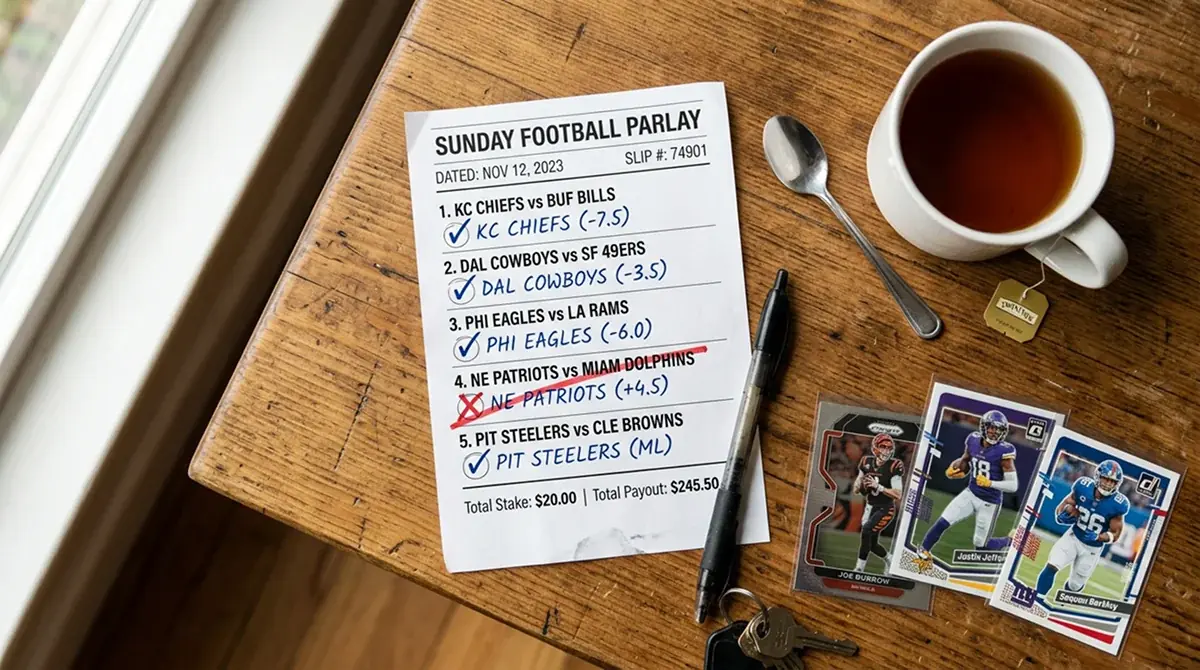
There is a screenshot on my phone from October 2019 that I still pull up when someone tells me accumulators are easy money. A six-leg NFL Sunday acca, five winners, one loser — the Dallas Cowboys failing to cover a four-point spread by exactly one point. The potential return was just over four hundred pounds from a five-pound stake. I got nothing. That is the accumulator experience in a single image: tantalisingly close, structurally stacked against you.
UK punters are wired for accumulators. The Premier League weekend acca is practically a national pastime, and when those same punters discover NFL — with its sixteen-game Sunday slate and dozens of available markets per match — the temptation to string together five, six, seven legs is irresistible. The global American football betting market sits at $8.52 billion in 2025 and is growing at 11.5% annually, driven partly by products like accumulators that turn a small stake into a headline-worthy payout.
The problem is mathematical. Every leg you add multiplies the sportsbook’s built-in margin. A single NFL spread bet might carry an overround of five to six percent. Two legs and you are paying roughly eleven percent. By the time you reach six legs, the cumulative margin can exceed thirty percent. The sportsbook does not need to beat you — the maths does it for them. The total regulated handle in the US alone hit $165.58 billion in 2025, with operators holding 10.15% of all wagers. Accumulators contribute disproportionately to that hold because the compounding effect of margin is invisible to the casual bettor.
See also: visit american football betting for the complete NFL betting library.
None of this means you should never build an NFL acca. It means you should build them with open eyes and a clear strategy, treating them as calculated shots rather than lottery tickets.
Selecting Legs: Correlation, Independence, and Value
I spent my first two NFL seasons picking acca legs by gut feel — whichever team I “fancied” that week. My records tell the story: 2% ROI on singles, minus 19% ROI on accumulators over the same period. The difference was not bad luck. It was bad leg selection.
The single most important concept in accumulator construction is independence. A traditional accumulator assumes that each leg’s outcome does not affect the others. If you back Team A to cover the spread and Team B to go over the total, those outcomes are genuinely independent — they happen in different stadiums, with different players. Your acca price reflects independent probabilities multiplied together, minus the sportsbook’s margin on each leg.
Where punters go wrong is selecting legs that look independent but carry hidden correlations. Backing three road favourites on the same slate feels diversified — different games, different teams. But road favourites as a class share systematic tendencies: they often face hostile crowds, deal with travel fatigue, and have their game scripts compressed by home teams playing aggressively early. You are not getting three independent bets; you are tripling down on one structural pattern.
Better approach: mix market types. Combine a spread pick with a totals pick from a different game and a moneyline underdog from a third. Each selection rests on a different analytical thesis. If your spread pick relies on a defensive matchup, your totals pick on pace of play, and your moneyline on perceived overreaction to a loss, the legs are as close to truly independent as NFL betting allows.
Value matters on every single leg. An accumulator is only as strong as its weakest price. If four of your five legs carry positive expected value but the fifth is a -EV pick you added “because it feels safe,” that fifth leg drags the entire acca into negative territory. Treat each selection as if it were a standalone bet you would be happy to place as a single. If you would not back it on its own, it has no business in your acca.
How Many Legs and How Much Stake
There is a persistent myth in betting forums that three-leg accumulators are the sweet spot. The logic sounds reasonable: fewer legs mean fewer points of failure and a more manageable margin hit. But “three legs” is an arbitrary number. The right number depends entirely on the strength of your edge on each individual selection.
If you have genuinely identified four independent selections where you believe the true probability exceeds the implied probability by at least three percentage points, a four-leg acca is smarter than a three-leg acca with one filler pick. Quality of edge beats quantity of legs every time.
That said, diminishing returns bite hard beyond four legs. At five legs, you need every selection to hit. The probability of a five-leg acca landing, even with a 55% strike rate per leg (which is excellent by NFL standards), is 0.55 to the power of five — roughly 5%. You are winning one in twenty. The odds offered need to compensate for that rarity, and after margin deductions, they rarely do.
For stake sizing, I apply a simple rule: my total accumulator exposure in any given week never exceeds 2% of my bankroll. If my bankroll is a thousand pounds, I have twenty pounds to spread across accumulators for the week. That might be one four-leg acca at twenty pounds, or two three-leg accas at ten pounds each, or four doubles at five pounds. The format matters less than the cap. Accumulators are high-variance by nature. Limiting your exposure means a losing run — and you will have losing runs — does not crater your overall position.
One more consideration: same-game parlays combine multiple selections from a single match. They are structurally different from traditional accas because the legs are inherently correlated. The pricing model is different, the strategy is different, and the margin structure is different. Do not confuse the two.
Accumulator Traps: Overconfidence, Banker Legs, and Odds Bias
Early in my career I tracked every NFL acca I placed for an entire season — 47 accumulators across seventeen weeks. The data revealed three patterns that were costing me money, and I see the same patterns in almost every casual bettor’s slip.
See also: prepare for the postseason with our NFL playoffs betting strategy article.
The first trap is the “banker leg.” This is the selection you consider a certainty, the one you build the rest of your acca around. In the 2024 season, I saw countless punters anchoring accas to Kansas City Chiefs moneyline — the reigning champions, the safest bet in football. Kansas City lost five regular-season games that year. Every one of those losses blew up thousands of accumulators. There are no certainties in the NFL, and the odds on so-called bankers are so short that they add almost nothing to your return while still carrying real risk of failure.
The second trap is odds bias — selecting legs because the combined odds “look good” rather than because each leg represents value. A five-leg acca at 25/1 is not inherently better than a three-leg acca at 6/1. If the three-leg version contains stronger individual selections, it has a higher probability of landing and likely offers better expected value despite the lower headline payout.
The third trap is ignoring scheduling context. NFL accumulators built on Thursday, Sunday early, Sunday late, and Monday games span four days. Injury reports update continuously. A leg you selected on Wednesday might look entirely different by Sunday morning after a starting quarterback is ruled out. Build your acca as late as practical — ideally after final injury designations are published, usually ninety minutes before kick-off. If a late scratch changes the profile of one of your legs, remove it rather than hoping for the best.
Discipline with accumulators comes down to a single question before every bet: am I building this acca because I have identified independent value on each leg, or am I building it because the potential payout excites me? If the answer is the latter, put the phone down and watch the games clean. There is nothing wrong with enjoying NFL without money on it — and there is nothing smart about burning bankroll on poorly constructed accas.
How many legs should an NFL accumulator ideally have?
There is no universal ideal. The right number depends on how many genuinely independent, positive-value selections you have identified. Most disciplined bettors cap NFL accas at three or four legs to keep cumulative margin manageable, but a two-leg double with strong edges beats a six-leg acca built on guesswork every time.
Do UK sportsbooks offer acca insurance on NFL bets?
Several UK sportsbooks run acca insurance promotions that refund your stake as a free bet if one leg lets you down. These offers appear more frequently during the NFL regular season and around the Super Bowl. Read the terms carefully — most require a minimum number of legs and minimum odds per leg, and the refund is typically a free bet rather than cash.
Is an NFL accumulator better value than individual singles?
Almost never. Singles preserve your edge on each selection without the compounding margin penalty that accumulators carry. Accumulators are best treated as a small, entertainment-budget portion of your overall staking plan — not as a primary strategy for long-term profitability.
Published by the American Football Betting team.