NFL Live Betting: In-Play Markets, Momentum Reads, and UK Platform Comparison
 Available in US

- How In-Play NFL Betting Differs from Pre-Match Markets
- Quarter-by-Quarter Markets: What Opens and When
- Reading Momentum Shifts for Live NFL Bets
- Injury Reports and Weather Changes During Live Games
- Comparing UK Sportsbook Live NFL Platforms
- Bankroll Discipline in Fast-Moving Live Markets
- Common Live Betting Traps for NFL Punters
- Live NFL Betting FAQ
How In-Play NFL Betting Differs from Pre-Match Markets
The first time I placed a live NFL bet, it was halftime of a Monday night game and I was watching from my sofa in south London at one in the morning. The favourite was trailing by 10, the live spread had flipped entirely, and I had about 45 seconds to decide whether to back the comeback before the third-quarter markets locked. That sense of urgency — thrilling and dangerous in equal measure — is what separates in-play NFL betting from everything you do before kick-off.
Pre-match markets are priced with days of information baked in: injury reports, weather forecasts, historical matchup data, public betting patterns. By the time you place a pre-match wager, the line has absorbed input from thousands of bettors and the sportsbook’s own model. It is a mature price. Live markets, by contrast, are repriced in real time after every snap, every scoring play, every injury. The odds you see at the start of the second quarter bear almost no resemblance to the ones available at the two-minute warning. This constant repricing creates both opportunity and chaos.
The scale of money moving through NFL markets overall — $30 billion in legal handle for the 2025 season alone, within a US market that processed $165.58 billion in total sports wagers that year at a hold rate of 10.15% — means that in-play pricing is driven by algorithms reacting to game state, not by a human oddsmaker watching the broadcast. These algorithms update spreads, totals, and moneylines within seconds of a play ending. For UK punters placing bets on a slight broadcast delay, this creates a structural disadvantage: the odds on your screen may already be stale by the time you tap the bet slip. Understanding this latency is the first step toward betting live profitably rather than reactively.
The other fundamental difference is the range of markets. Pre-match, you might see 80 to 120 individual markets for a marquee NFL game on a UK sportsbook — spreads, totals, player props, team props, quarters, halves. In-play, many of those markets close or narrow. Player prop markets typically suspend during live action. What remains are the core lines: live spread, live total, live moneyline, and sometimes next-scoring-play or drive-result markets. The menu shrinks, but the pace at which it changes accelerates dramatically.
See also: visit american football betting for the latest NFL wagering tips.
Quarter-by-Quarter Markets: What Opens and When
NFL games are divided into four 15-minute quarters, plus overtime if needed, and each quarter generates its own set of betting markets. I find this structure genuinely appealing for live betting because it creates natural breakpoints — moments where the market pauses, recalibrates, and reopens with fresh lines. If you have ever found the continuous flow of Premier League in-play betting overwhelming, the NFL’s stop-start rhythm might suit you better.
First-quarter markets are the closest to pre-match pricing. The game has not revealed much information yet, so the live spread and total remain anchored to the opening numbers with modest adjustments for any early scoring. The first-quarter spread itself — a separate market from the full-game spread — is typically set at 0.5 or 1.5 points, reflecting the low-scoring nature of opening drives when both teams are feeling each other out. I treat first-quarter bets as low-information propositions: they are more about game theory and tendencies (does this team script strong opening drives?) than about anything the live broadcast is showing you.
Second-quarter markets shift noticeably. By now, both offences have run 15 to 20 plays and you can see whether the game script matches pre-match expectations. If a team that was supposed to dominate on the ground is instead throwing 70% of the time, something has changed — perhaps they fell behind early and abandoned the run. The halftime line, which prices the second-half spread, opens during the second quarter on most UK sportsbooks and remains available through the intermission. This is one of the most interesting windows in live NFL betting, because the halftime spread reflects second-half adjustments that the market can only guess at.
Third-quarter markets are where I spend most of my live betting attention. Coaches have made halftime adjustments, injury updates are confirmed, and the game flow is established. The third quarter also has a well-documented statistical quirk: favourites tend to reassert themselves after halftime. Teams with better coaching staffs exploit halftime to correct first-half problems, and the scoring distribution reflects this. If a favourite trails at the half, the live spread in the third quarter often still favours them — the market prices in the expected adjustment before it happens.
Fourth-quarter markets become chaotic. Trailing teams abandon conservative play-calling, leading to more turnovers, more long passes, and more volatile scoring. The live total swings wildly. Clock management becomes a factor — a team with a two-score lead may run the ball exclusively, draining clock and reducing total points. A team down by eight needs a touchdown and a two-point conversion, changing the probability distribution of every remaining drive. I find fourth-quarter live betting the hardest to do well and the easiest to lose money on. The volatility feels exciting, but the odds reprice so quickly that you are almost always buying at a premium.
Reading Momentum Shifts for Live NFL Bets
“Momentum” is one of the most overused words in sports commentary, and I spent years dismissing it as narrative fluff. Then I started tracking in-play line movement against game events and realised that while momentum as a mystical force is nonsense, momentum as a proxy for shifts in play-calling, confidence, and defensive alignment is very real — and very exploitable.
The clearest momentum signal in an NFL game is a turnover. When a team intercepts a pass or recovers a fumble, the live spread lurches. The algorithms react to the change of possession, the field position, and the expected points from the new drive. But here is the key insight: the market overreacts to turnovers in real time. A single interception does not change a team’s fundamental quality. It changes the immediate game state, but within two or three possessions, the pre-game equilibrium tends to reassert itself. If you have the discipline to bet against a turnover-driven momentum swing — backing the team that just committed the error, at an inflated live spread — you are capturing a systematic inefficiency.
Scoring runs are another momentum marker. If one team scores on three consecutive possessions, the live line will reflect an assumption that the run continues. Sometimes it does. More often, NFL games regress toward competitive balance because defences adjust scheme, coaching staffs call timeouts to reset, and the trailing team shifts to a more aggressive offensive approach that generates both big plays and turnovers. The art of live betting is distinguishing between a scoring run that reflects genuine dominance (a mismatch that the losing team cannot scheme around) and a run that reflects variance (a couple of fortunate bounces, a short field from a fumble recovery).
I use a simple framework: after a scoring run, I ask two questions. First, is the scoring team generating yards efficiently, or are they benefiting from short fields and turnovers? Efficient yards suggest real dominance. Short fields suggest variance. Second, is the trailing team’s offence being stopped, or are they simply not getting possessions? If the trailing team is moving the ball but failing in the red zone or losing time-of-possession battles, the underlying quality gap may be smaller than the scoreboard suggests. These are not complex analytics — you can assess them from the TV broadcast and the basic stats overlay that most sportsbook apps now provide during live games.
One more momentum pattern worth watching: the two-minute drill effect. Teams trailing by one score with two minutes left in the first half often shift into a hurry-up offence that generates quick yards and field-goal attempts. The live total usually rises during these drives, but the resulting points are already partially priced into the second-half total. If you are considering a second-half under, a late first-half scoring drive by the trailing team is often your entry signal — the market assumes the scoring pace will continue, when in reality the second half opens with a fresh dynamic.
Injury Reports and Weather Changes During Live Games
In October 2024, I watched a live spread shift by four full points in under two minutes. The cause was not a touchdown or a turnover — it was a quarterback limping to the sideline and the backup warming up. Injuries during live games create the most violent line movements in NFL betting, and if you are watching the broadcast rather than a data feed, you are seeing them after the market has already moved.
Quarterback injuries are the most impactful because no position in professional sport carries more individual leverage over a team’s performance. When a starting QB exits, the live spread can swing anywhere from 3 to 7 points depending on the quality gap between the starter and the backup. Skill-position injuries — a top receiver or running back going down — produce smaller but still measurable shifts, typically 1 to 2 points. Defensive injuries tend to move the total more than the spread, because a weakened secondary or pass rush means more points for the opposition without necessarily changing the projected winner.
The practical challenge for UK punters is speed. NFL sportsbook algorithms ingest injury information from official sources and social media feeds faster than any broadcast. By the time the TV commentator says “and it looks like he’s heading to the locker room,” the line has already adjusted. This does not mean you should ignore injury information — it means you should not chase it. If you see a QB go down and the live spread has already moved four points, that movement already prices in the downgrade. The question becomes whether the market has overreacted or underreacted, and that requires knowledge of the backup quarterback’s capability. If you follow NFL rosters closely enough to know the backup’s arm strength, mobility, and experience, you have an informational edge that most recreational bettors lack.
Weather changes during games are rarer but equally disruptive. Wind and rain directly affect the passing game: completion rates drop, punt distances shorten, and kicking accuracy falls. If a storm rolls in during the second quarter of an outdoor game, the live total drops immediately. Snow games are the most dramatic — visibility drops, footing becomes unreliable, and game scripts shift toward run-heavy approaches that chew clock and suppress scoring. For UK punters watching late-season games in December and January, weather awareness is not optional. Check forecasts before kick-off, but also monitor conditions during the game — a gust that was not in the forecast can rewrite the live total within a single drive.
Comparing UK Sportsbook Live NFL Platforms
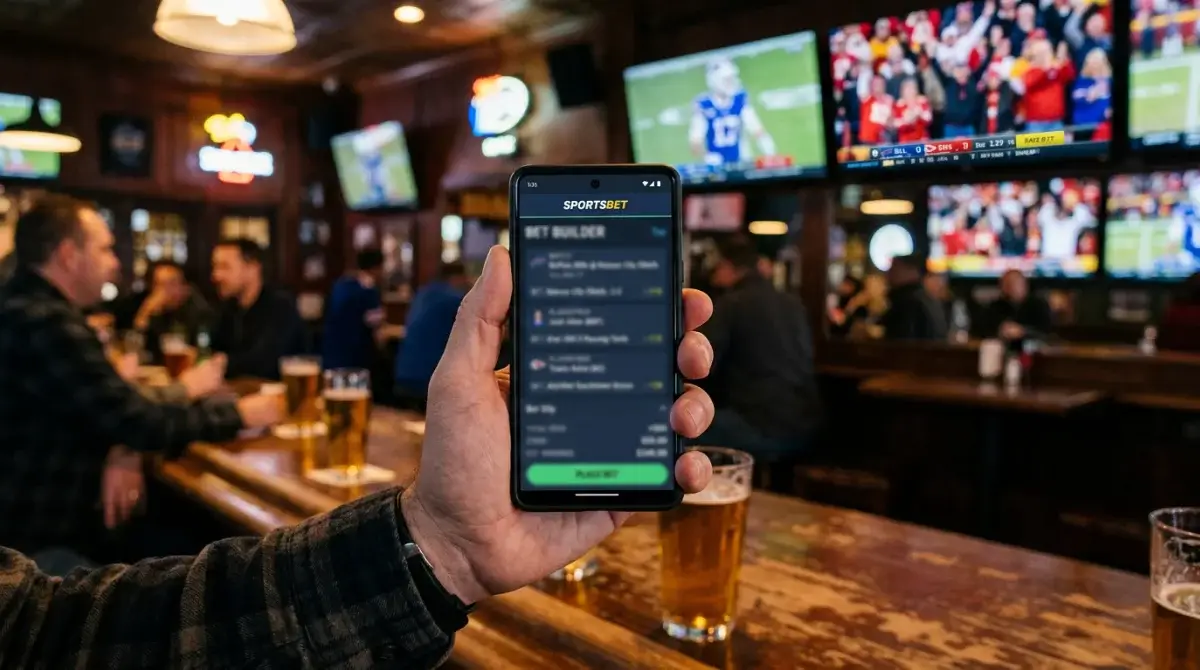
Not all live betting experiences are created equal, and I have spent enough Sunday nights switching between apps to have strong opinions on what separates a usable in-play platform from a frustrating one. With 76% of young UK bettors placing wagers on their phones and 95% of all online bets coming from home, the mobile live betting interface is where you will spend most of your time — and small differences in speed, layout, and market depth compound over a season.
The first variable is latency. When you tap a live bet, there is a delay while the sportsbook confirms the odds have not changed since you loaded the page. This delay varies from under two seconds on the fastest platforms to over five seconds on slower ones. A five-second delay during a fast-moving NFL drive can mean the difference between catching a favourable live spread and seeing your bet rejected because the line has moved. I have found that the major UK operators with dedicated in-house trading desks tend to offer faster confirmation times than those relying on third-party feeds. You will not find latency figures published anywhere — you discover them through experience.
The second variable is market depth. Some UK sportsbooks maintain live spread, moneyline, and total markets throughout the entire game, including overtime. Others suspend markets during certain game phases — inside the two-minute warning, during official reviews, or after turnovers. A few offer live drive-result markets (will this drive end in a touchdown, field goal, punt, or turnover?) and next-scoring-play markets that are not available pre-match at all. If you plan to bet live regularly, you want access to these niche markets, because they are where the algorithms are least refined and value is most likely to appear.
The third variable is cash-out functionality. Cashing out a live bet before the game ends locks in a profit or limits a loss based on the current live odds. Not all UK sportsbooks offer cash-out on NFL in-play bets, and among those that do, the terms differ. Some apply a margin to the cash-out offer that makes it significantly worse than the theoretical fair value. Others restrict cash-out to single bets and exclude accumulators. If cash-out discipline is part of your live betting approach, test the feature with small stakes on a couple of platforms before committing to one as your primary account.
The fourth — and often overlooked — variable is live data integration. The best platforms display real-time drive charts, down-and-distance information, and possession indicators alongside the betting markets. This data helps you make informed decisions without switching to a separate app or website. Platforms that show only the score and the clock leave you guessing about game context, which is a significant disadvantage when you are trying to read momentum or assess whether a scoring run is sustainable. Ten percent of the UK population bets on sport actively; the platforms that serve those punters best are the ones that treat data as integral to the betting experience, not as an afterthought.
Bankroll Discipline in Fast-Moving Live Markets
I lost more money in my first month of live NFL betting than in my previous six months of pre-match wagers combined. The reason was not bad analysis — it was volume. Live betting is seductive because the opportunities feel endless: every play creates a new game state, every new game state creates a new line, and every new line whispers that this is the spot. Before you know it, you have placed 15 bets on a single game, and variance has eaten your bankroll alive.
The fundamental rule I now follow is this: live bets come from the same bankroll and the same unit size as pre-match bets. There is no separate “live fund.” If your standard unit is 2% of your bankroll on a pre-match spread, it is 2% on a live spread too. The temptation to increase stakes live — because you have “seen something” the market has not — is almost always the recency bias talking. You saw a big play, your adrenaline spiked, and you convinced yourself that the live line was wrong. Sometimes it is. More often, you are reacting emotionally to visual information that the algorithm has already priced in.
Grainne Hurst, CEO of the Betting and Gaming Council, has noted that the industry’s commitment to raising standards means ensuring millions of regular punters gamble safely. That commitment matters especially in live markets, where the speed of play can override rational decision-making. I set a hard cap on live bets per game — three is my maximum for a standard regular-season match, five for a playoff game where I have done extensive preparation. This is not a suggestion. It is a rule I enforce by closing the app after my third bet. If I feel the urge to place a fourth, I remind myself that the urge itself is the clearest signal that I should stop.
There is also a staking nuance specific to live betting. Pre-match, you have time to research, model, and calibrate your confidence in a bet. Live, you have seconds. The reduced preparation time should reduce your stake, not increase it. I use half-units on live bets unless my pre-game analysis identified a specific live scenario I was waiting for — a halftime spread on a team I expected to trail early, for instance. In that case, I am not reacting to the game. I am executing a pre-planned strategy, which merits full-unit sizing. The distinction between reactive and planned live bets is the single most important line in bankroll management for in-play wagering.
Common Live Betting Traps for NFL Punters
Beyond the bankroll issues, live NFL betting has specific structural traps that catch even experienced punters. I have fallen into all of them at various points, and the only reason I can describe them clearly is that I tracked each mistake in my betting journal and forced myself to review them at the end of each season.
See also: sharpen your in-play approach with our NFL halftime betting strategy.
The broadcast delay trap is the most insidious. UK punters watching NFL on Sky Sports, the NFL’s own Game Pass, or streaming services are typically 5 to 30 seconds behind real time. The sportsbook’s algorithm, however, reacts to live data feeds with near-zero delay. This means you will occasionally see a “value” live line that looks too good to be true — because it is. The line has already been updated to reflect a play you have not yet seen on your screen. If a live line suddenly looks generous for no apparent reason, do not rush to back it. Wait for your broadcast to catch up and confirm the game state before committing.
The “hedge everything” trap appeals to cautious bettors. You back a team pre-match at -3, they jump to a 14-point lead, and you are tempted to hedge by backing the opposition on the live spread to guarantee a profit regardless of outcome. Hedging is not inherently wrong, but it is almost always mathematically inferior to letting the original bet play out. The sportsbook’s margin on the live bet erodes your guaranteed profit, and the scenarios where you actually need the hedge (a full-blown collapse from a 14-point lead) are rarer than your anxiety suggests. I hedge only when the guaranteed amount exceeds my full-season unit size — anything less, and the margin cost is not worth the peace of mind.
The narrative trap is uniquely powerful in NFL broadcasts. American sports coverage is saturated with storylines: comeback narratives, revenge games, legacy-defining performances. These narratives are compelling television but terrible betting signals. A team trailing by 10 in the fourth quarter is not “due for a comeback” because the commentator is building dramatic tension. The live spread already prices in the probability of a comeback based on historical data, time remaining, and timeout availability. If you are placing live bets based on the emotional arc of a broadcast rather than the mathematical state of the game, you are entertainment, not a bettor.
Finally, the fatigue trap. NFL games involving UK punters often run past midnight, and late-season Sunday night or Monday night games can stretch to 1:30 or 2:00 AM. Cognitive function degrades with fatigue, and the quality of your live betting decisions at 1:45 AM is categorically worse than at 6:15 PM. I no longer place live bets in the fourth quarter of late games unless I have a pre-planned scenario. The edge I might find is smaller than the error my tired brain is likely to introduce. For deeper strategies on maintaining discipline across a full season of NFL wagering, the touchdown scorer betting guide covers how to stay selective in the most tempting markets.
Live NFL Betting FAQ
Which UK sportsbooks offer the widest range of in-play NFL markets?
The major UK-licensed operators with dedicated sports trading desks tend to offer the deepest live NFL menus, including drive-result and next-scoring-play markets alongside standard live spreads, totals, and moneylines. Market depth varies by game — primetime matchups (Sunday Night, Monday Night, Thursday Night) typically have more live markets than early-window Sunday games. Test multiple platforms during the preseason to compare.
How quickly do live NFL odds update after a scoring play?
On the fastest UK sportsbook platforms, live odds update within 2 to 5 seconds of a scoring play being confirmed by the official data feed. Slower platforms may take up to 10 seconds. Because UK TV broadcasts run 5 to 30 seconds behind real time, the odds on your screen may already reflect a play you have not yet seen. Always wait for your broadcast to catch up before acting on a sudden line change.
Can I cash out an in-play NFL bet before the game ends?
Most major UK sportsbooks offer cash-out on live NFL bets, though availability varies. Some restrict cash-out to single bets and exclude accumulators. Others apply a margin to the cash-out offer that reduces its value compared to the theoretical fair price. Check each sportsbook’s terms for NFL-specific cash-out rules before relying on this feature as part of your live strategy.
Is live NFL betting more profitable than pre-match betting?
Not inherently. Live betting offers more frequent opportunities but also introduces structural disadvantages: broadcast delays, faster-moving margins, and emotional decision-making under time pressure. Profitable live bettors typically use pre-planned scenarios identified before kick-off rather than reacting to the broadcast in real time. The same discipline and bankroll management principles apply to both pre-match and in-play wagering.
Written by the editors at American Football Betting.