NFL Handicap Betting for UK Punters: Alternative Spreads and Asian Lines
 Available in US
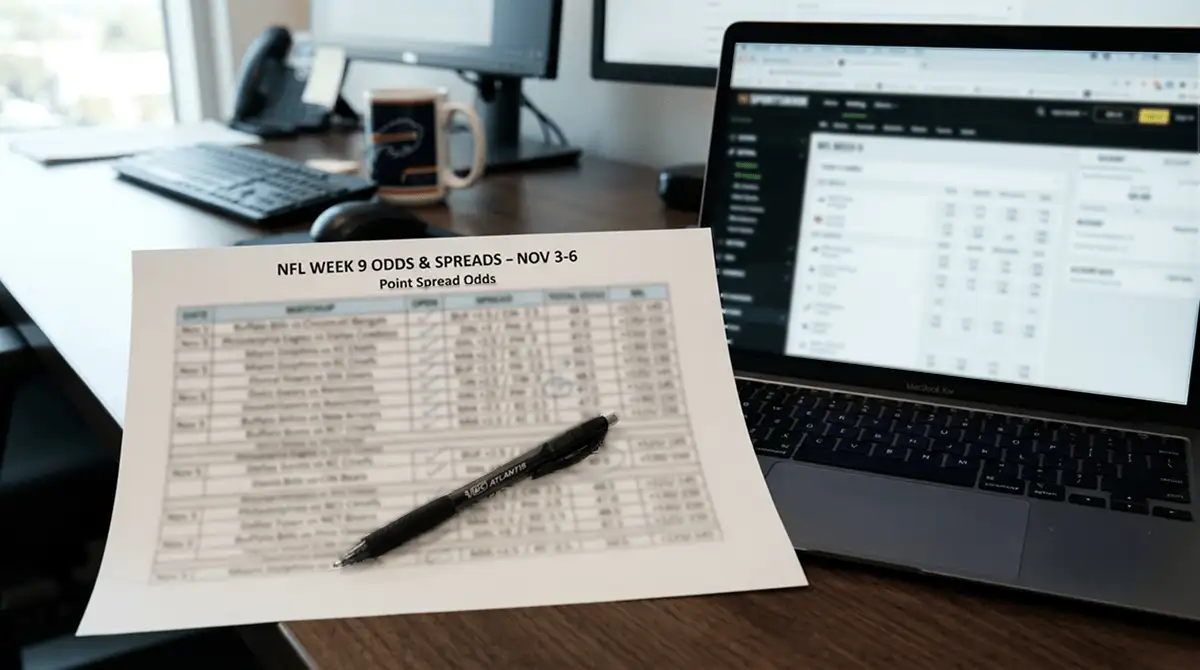
Standard Spreads vs Alternative Handicaps: What UK Bettors Miss
I spent my first year of NFL betting thinking the point spread was one fixed number. Team A -3.5, Team B +3.5, take it or leave it. Then I stumbled into the alternative handicaps section of my sportsbook and felt like someone had opened a second floor in a building I thought I knew. Suddenly I could back a team at -1.5 for shorter odds, or -7.5 for longer odds, or any increment in between. The game had not changed — but the ways I could bet on it had multiplied overnight.
Point spread betting is the most popular market in American football, and the standard spread — the headline number set by the sportsbook — is where most of the action flows. But UK sportsbooks also offer alternative handicaps: a menu of spreads ranging from the standard line down to much larger or smaller numbers, each priced according to its probability. These alternative lines are the handicap bettor’s toolkit, and they reward punters who think not just about which side wins but about how confidently they hold that view.
The global American football betting market reached $8.52 billion in 2025, and alternative handicaps contribute a growing share of that volume because they let punters calibrate risk precisely. Instead of accepting the market’s default framing, you choose your own threshold — and the price adjusts accordingly.
See also: browse american football betting for the best NFL betting resources.
How Alternative Handicaps Are Priced and Where Value Hides
During the 2024 playoffs, I wanted to back a strong favourite but the standard spread of -6.5 did not excite me. The moneyline was too short at 1.28. So I looked at the alternative handicaps and found -3.5 at 1.50 — a line that gave the team a wider margin for error while offering a meaningful return. They won by four. The standard spread lost; my alternative handicap cashed.
Alternative handicaps are priced relative to the standard spread. Moving the line in your favour (buying points) shortens the odds; moving it against you (selling points) lengthens them. The sportsbook adjusts the price in increments that reflect the probability density around each point threshold. In the NFL, those probabilities are not evenly distributed — they cluster around key numbers like 3, 7, and 10 because of the scoring structure. Crossing through a key number costs more than crossing through a non-key number, and that asymmetry is where the pricing gets interesting.
Buying through 3 — moving from -3.5 to -2.5, or from +2.5 to +3.5 — is the most expensive single-point adjustment in NFL handicap betting. About 15% of NFL games are decided by exactly three points, so that one-point move captures a large slice of the probability distribution. Buying through 7 is the second most expensive, capturing the roughly 9% of games decided by exactly a touchdown. Moving through non-key numbers — from -5.5 to -4.5, for instance — costs less because fewer games land on those margins.
The value opportunity: sportsbooks price alternative handicaps using a standardised model, but that model sometimes fails to capture game-specific factors. If you believe a particular matchup is likely to produce a blowout — say, an elite team hosting a struggling opponent in divisional play — the alternative handicap at -10.5 or -13.5 might be underpriced because the model assumes a more moderate range of outcomes. Conversely, if you think the market is overestimating a favourite’s dominance, buying the underdog up from +3.5 to +7.5 at a modest price might offer better risk-adjusted value than the standard line.
Asian Handicaps on NFL: How They Differ from Standard Spreads
UK punters who bet on football know Asian handicaps well — they eliminate the draw from the equation by using quarter-point lines that split the stake across two handicaps. Some UK sportsbooks have started offering Asian handicap-style markets on NFL games, and the format introduces subtle but meaningful differences from standard American spreads.
A standard NFL spread of -3.5 has two outcomes: cover or not cover. An Asian handicap of -3.25 splits your stake into two halves: one on -3 and one on -3.5. If the favourite wins by exactly three, half your bet pushes (returned) and half loses. If they win by four or more, both halves win. If they win by two or fewer (or lose), both halves lose. This half-win/half-loss mechanism provides a smoother risk profile than a binary spread, particularly around the key number of 3.
The pricing on Asian handicap NFL markets is typically tighter than on standard alternative spreads because Asian handicap markets are designed to attract balanced two-way action. The overround on an Asian handicap NFL line can be as low as 2-3% at some operators, compared to 4-5% on the standard spread. For punters who trade volume and prioritise margin efficiency, Asian handicaps on NFL offer some of the best pricing available at UK sportsbooks.
One practical consideration: not every UK operator offers Asian handicaps on NFL. The format is standard for football but remains niche for American sports. During the 2025 season, I found Asian handicap NFL options at three of the eight sportsbooks I regularly use. If the format suits your style, confirm availability before the season starts.
Practical Framework: Choosing Between Standard and Alternative Lines
Here is the decision tree I use every week during the NFL season when evaluating handicap options.
First, I set my own line — my best estimate of the true spread for the game. If my line is -4 and the sportsbook’s standard spread is -3.5, the standard line offers value and I take it without overcomplicating things. The half-point difference in my favour is enough.
See also: master spread-based wagering with our NFL point spread explained guide.
Second, if my line diverges by two or more points from the standard spread, I explore alternative handicaps. A two-point divergence suggests the market’s pricing is meaningfully different from my assessment, and the alternative menu lets me find the specific line where my perceived edge is largest. More than 13 million NFL followers in Britain represent a growing pool of bettors who are learning to shop not just across sportsbooks but across line options within a single operator.
Third, I consider the game’s likely script. If I expect a close, low-scoring game, the probability distribution clusters around small margins — and the standard spread plus or minus one point covers most realistic outcomes. Alternative handicaps add limited value in tight games. But if I expect a one-sided affair, the distribution spreads wide, and the alternative handicaps at -10.5, -13.5, or even -17.5 start to offer genuine pricing opportunities.
The broader strategies guide covers how to integrate handicap selection into a full-season approach, but the core principle is straightforward: the standard spread is a default, not a mandate. Every game offers a menu of handicap options, and the disciplined bettor picks the one where the price best matches their conviction.
What is the difference between a point spread and an alternative handicap in NFL betting?
The point spread is the headline line set by the sportsbook for a given game — the default number. Alternative handicaps let you adjust that number higher or lower, with the odds changing accordingly. Buying points in your favour shortens the price; selling points against you lengthens it. The underlying bet is the same — which team covers the adjusted margin — but the risk-reward profile changes with every line adjustment.
Do UK sportsbooks offer Asian handicaps on NFL games?
Some do, but availability is inconsistent. Asian handicaps are standard for football but remain niche for American sports at UK operators. Check your sportsbook’s NFL match page for Asian handicap or quarter-line options. Operators that cater to sharp bettors or have strong Asian market operations are more likely to carry them.
Is buying points through key numbers 3 and 7 worth the cost?
It depends on the specific price. Moving through 3 captures roughly 15% of NFL outcomes, and through 7 captures another 9%. The sportsbook charges a premium for these moves. If the price to buy through 3 is less than the probability improvement — which requires comparing your estimated win probability at each line — the purchase adds value. If the sportsbook overcharges, it does not. Run the numbers rather than following a blanket rule.
Created by the ”American Football Betting” editorial team.