NFL Odds Explained for UK Bettors: Fractional, Decimal, and American Formats
 Available in US
Why NFL Odds Look Different from Premier League Lines
The first time I looked at an NFL line on a US-facing site, I saw “-110” next to a point spread and had absolutely no idea what it meant. I had been betting on Premier League football for years — fractional odds were second nature, and I had recently switched my default display to decimal. But American odds? Minus signs, plus signs, numbers that did not convert to anything intuitive? It felt like learning a new language just to place a spread bet.
That confusion is universal among UK punters entering NFL betting. Ten percent of the British population actively participates in online sports betting, and the overwhelming majority of those punters learned to read odds in fractional or decimal format. NFL markets, however, originate in the United States, where American odds are the standard. When UK sportsbooks import those lines, they convert them — but the conversion is not always clean, and understanding all three formats gives you an analytical advantage that most casual bettors never bother to develop.
The three formats express the same underlying probability. A selection priced at 6/4 in fractional, 2.50 in decimal, and +150 in American is the exact same bet with the exact same implied probability of 40%. The format is just a lens. But each lens reveals different things more clearly, and switching between them depending on what you are trying to evaluate is a skill worth building.
See also: visit american football betting for the full range of NFL guides.
Fractional Odds on NFL Markets: Reading and Calculating
If you grew up betting on horse racing or football in the UK, fractional odds are your mother tongue. 5/1 means you win five pounds for every pound staked. 1/2 means you win fifty pence for every pound staked. The number on the left is potential profit; the number on the right is the stake required to earn that profit.
On NFL markets, fractional odds work identically but the numbers can feel unfamiliar. A moneyline favourite might be listed at 4/9, which means you need to stake nine pounds to win four. An underdog might sit at 11/4 — stake four, win eleven. Point spreads, which are typically priced close to even money, show up as 10/11 or 5/6, reflecting the sportsbook’s built-in margin (vig or juice in US terminology, overround in UK parlance).
Calculating your return in fractional odds: multiply your stake by the fraction, then add your stake back. A twenty-pound bet at 7/2 returns (20 x 3.5) + 20 = 90 pounds total (70 profit plus 20 stake). For implied probability, divide the denominator by the sum of numerator and denominator: at 7/2, that is 2 / (7 + 2) = 22.2%.
The limitation of fractional odds is comparison. Is 11/8 better than 6/4? You can work it out, but it takes a moment. When you are line shopping across three sportsbooks for an NFL spread, that moment adds friction. This is why many serious bettors switch to decimal.
Decimal Odds: The Format Most UK Sportsbooks Default To
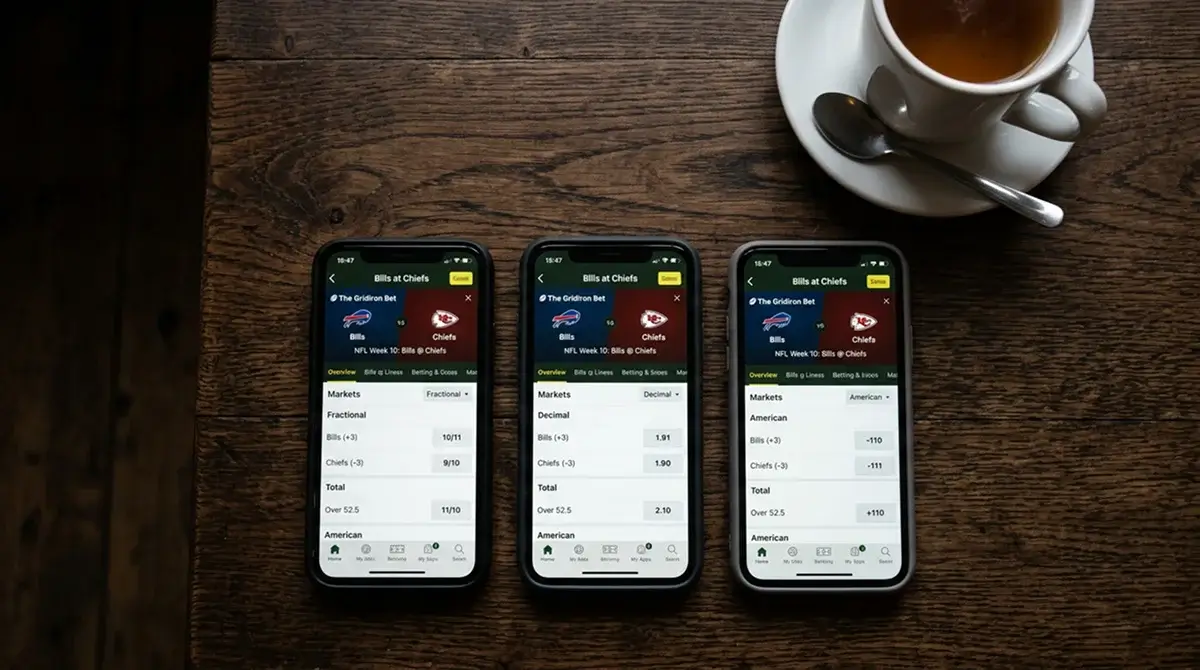
I switched to decimal odds in 2019 and have not looked back. Roughly 76% of young UK adults aged 18-24 bet on mobile, and every major sportsbook app defaults to decimal or offers a one-tap switch. The appeal is arithmetic simplicity: decimal odds represent the total return per pound staked, including your stake. At 2.50, a one-pound bet returns two pounds fifty. At 1.91 — the standard NFL spread price — a one-pound bet returns one pound and ninety-one pence.
Calculating implied probability is cleaner: divide one by the decimal odds. At 2.50, the implied probability is 1 / 2.50 = 40%. At 1.91, it is 1 / 1.91 = 52.4%. That 52.4% is crucial — it tells you that the sportsbook expects the selection to win slightly more than half the time. If you believe the true probability is 55%, the bet has positive expected value. If you think it is 50%, you are paying a premium.
Comparing prices across sportsbooks is instantaneous in decimal. Is 1.95 better than 1.91? Obviously. Is 2.45 better than 2.40? Yes. No mental arithmetic required. For NFL betting specifically, where spread prices typically cluster in a narrow range between 1.85 and 2.00, that instant comparison matters — the difference between 1.91 and 1.95 on a hundred bets across a season adds up to real money.
American Odds: Understanding Plus and Minus Lines
American odds use positive and negative numbers centred around a baseline of 100. A negative number tells you how much you need to stake to win one hundred units. -110 means stake 110 to win 100. A positive number tells you how much you win on a stake of one hundred. +150 means a hundred-unit stake wins 150.
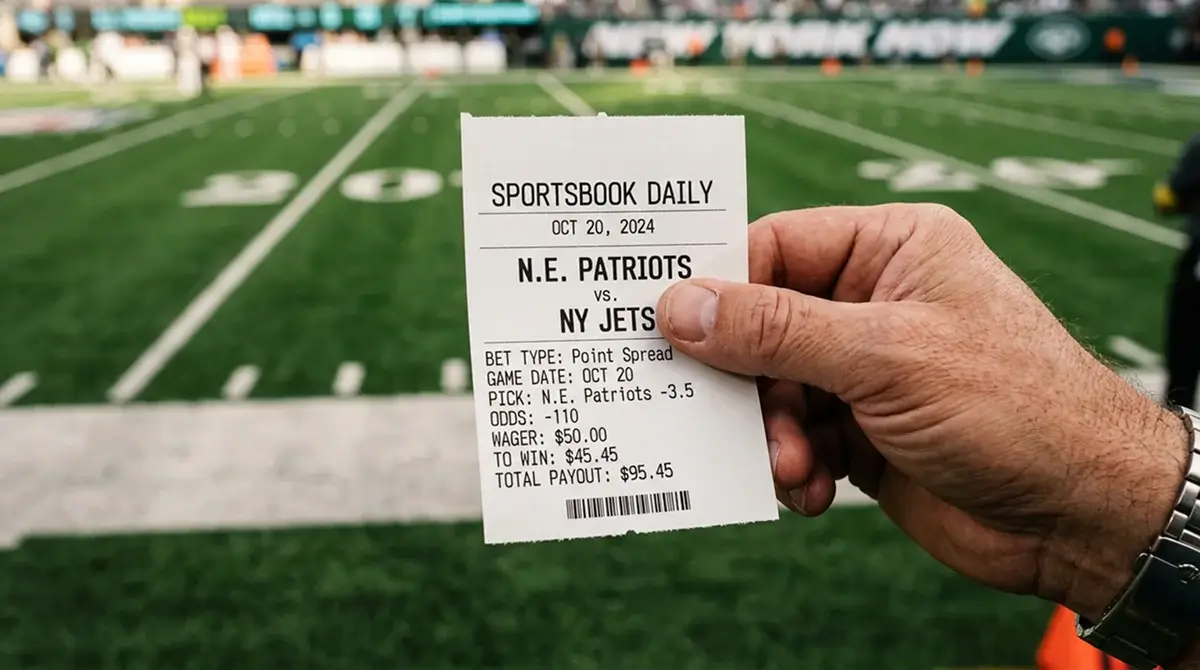
The standard NFL spread price in the US is -110 on both sides, which converts to 1.91 decimal or 10/11 fractional. That -110 is where the sportsbook’s margin lives: if both sides are equally likely (50/50), but both are priced at -110, the implied probabilities sum to 52.4% + 52.4% = 104.8%. The 4.8% overshoot is the overround — the sportsbook’s mathematical edge on the market.
You will encounter American odds primarily when reading US-based analysis, following line movement on American sports media, or using odds comparison sites that default to American format. Most UK sportsbooks display NFL lines in decimal or fractional, but understanding the American format lets you consume a much wider pool of analytical content. When a US sharp bettor tweets that they “got the Chiefs at -3 -105,” you need to know that -105 is better than the standard -110 — they got a price advantage.
Converting Between Formats: Quick Formulas
Rather than memorising complex formulae, I use three conversions that cover every situation I encounter during an NFL season.
See also: apply your odds knowledge to moneyline markets in our NFL moneyline betting guide.
American to decimal: if the American odds are negative, divide 100 by the absolute value of the odds, then add 1. For -110: (100 / 110) + 1 = 1.909. If positive, divide the odds by 100, then add 1. For +150: (150 / 100) + 1 = 2.50.
Decimal to fractional: subtract 1 from the decimal odds, then express as a fraction. 2.50 becomes 1.50/1, which simplifies to 3/2. 1.91 becomes 0.91/1, which approximates to 10/11. For clean fractions, round to the nearest common fractional representation — sportsbooks do this automatically, which occasionally introduces tiny rounding discrepancies.
Decimal to implied probability: divide 1 by the decimal odds. 1.91 gives 52.4%. 2.50 gives 40%. This is the single most useful conversion for evaluating any NFL bet because it translates the price into a percentage you can compare against your own probability estimate.
All three formats are lenses on the same underlying reality. The format does not change the bet, but it changes how easily you can spot value. I keep my sportsbook apps set to decimal for quick comparison, use a mental conversion to American when reading US analysis, and occasionally check fractional when an older punter asks me to explain a point spread in terms they recognise. Fluency across formats is a small investment that pays off every week of the NFL season.
Which odds format is best for comparing NFL lines across UK sportsbooks?
Decimal odds are the most efficient for comparison because higher numbers always mean better prices, and the arithmetic for calculating returns and implied probability is simpler than fractional or American formats. Most UK sportsbook apps allow you to switch to decimal in settings.
How do I convert American +150 odds to UK fractional?
First convert to decimal: divide 150 by 100, then add 1, giving 2.50. Then subtract 1 to get 1.50, and express as a fraction: 3/2. So +150 in American equals 3/2 in fractional, which means you win three pounds for every two pounds staked.
Written by the editors at American Football Betting.